
Ogle La La 3.0
Cebu’s Heritage Is Not a Museum Piece, Darlings
by Alexandra Fortabat de Hermès | illustrations by Edge Javier
I had planned to write about something lighter, perhaps the cultural importance of good linen, cold wine, and why some people should never be allowed near buffet tongs. But Cebu, as usual, had other plans.
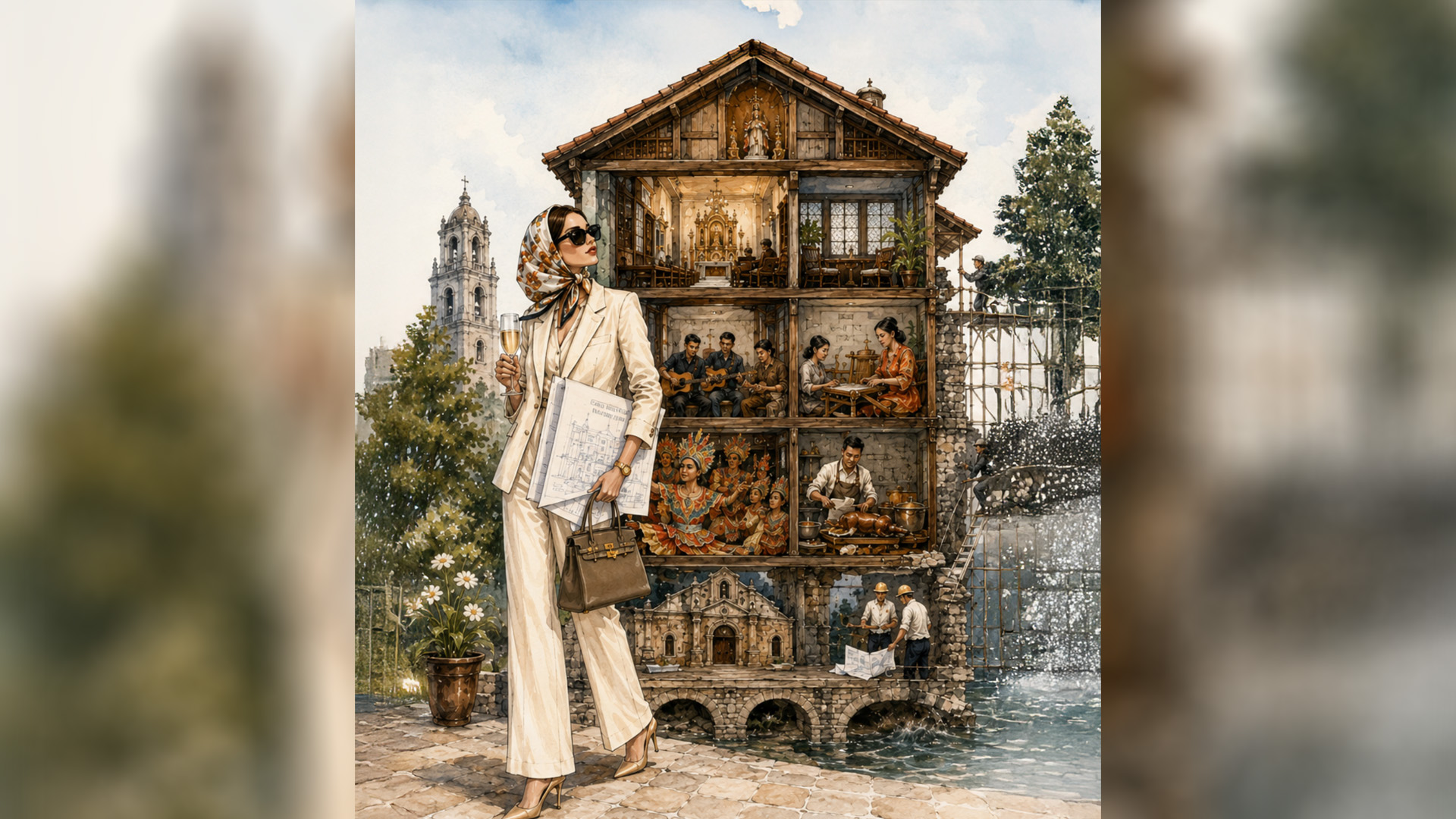
One cannot live here and pretend that heritage is a charming little side table in the corner. In Cebu, heritage is not decorative. It is load-bearing. It holds up our churches, our kitchens, our festivals, our export industries, our accents, our stubbornness, our lechon opinions, and that very Cebuano confidence that says, with terrifying calm, “kaya ra.” Sometimes, it really is kaya. Sometimes, querida, it needs scaffolding.
Cebu has always had the nerve to be old and future-facing at the same time. Before the colonial postcards, before the mall atriums, before every capiz window became “content,” Cebu was already a trading hub connected to China, India, Borneo, and Southeast Asia. Trade, faith, food, craftsmanship, and reinvention have always been part of the Cebuano bloodstream.
This is why the current state of heritage and culture in Cebu is so fascinating, and so fragile. It is alive, yes. Very alive. It dances in Sinulog, cooks humba and balbacua, sings through guitars from Mactan, argues in Bisaya, survives in ancestral houses, and reappears in fashion jewelry, furniture, food, festivals, design, and disaster response. But it is also under pressure from development, climate shocks, political inconsistency, and that classic Cebuano disease: waiting until the roof leaks before looking for the blueprint.
The good news is that heritage is no longer being treated only as an old building with a plaque. The Cebu Provincial Heritage Commission has been revived after years of inactivity, with plans to amend the 2008 heritage ordinance to cover not just buildings, monuments, and landscapes, but also oral history, performing arts, rituals, traditional knowledge, and other forms of intangible heritage.
This matters. Because heritage is not only stone, it is also memory. It is not only a church façade. It is also the hand that knows how to carve, weave, cook, pray, repair, repurpose, and improvise. In Cebu, the intangible has always carried the tangible. The fiesta keeps the plaza alive. The procession keeps the street meaningful. The recipe keeps the family archive edible. The language keeps the worldview sharp.
Cebu has always had the nerve to be old and future facing at the same time.
There are beautiful signs of institutional progress. The National Museum of the Philippines in Cebu, housed in the restored Aduana building, is exactly the kind of adaptive reuse Cebu needs more of: dignified, practical, educational, and photogenic without screaming for attention in a sequined tube top.
Programs like Gabii sa Kabilin have also helped make heritage social again, not just academic. When museums, old houses, churches, and cultural sites become part of how people move through the city at night, heritage stops being homework and becomes an experience. Cebuano culture is strongest when it is not trapped in a glass case. It needs footsteps, stories, food stalls, heat, music, gossip, children running where curators wish they would not, and a grandmother explaining things better than any QR code ever could.
And then came the reminders. Earthquakes damaged heritage churches in northern Cebu. Typhoons brought floods, anxiety, and the brutal clarity that beauty without resilience is not enough. So let us be clear. Heritage conservation in Cebu can no longer be about nostalgia alone. It must now be about survival.
A heritage church that cannot withstand earthquakes, a heritage district that floods, a heritage street severed from daily life, a traditional craft with no apprentices, a festival reduced to branding, a language treated as provincial instead of powerful: these are not romantic losses. These are system failures wearing antique jewelry.
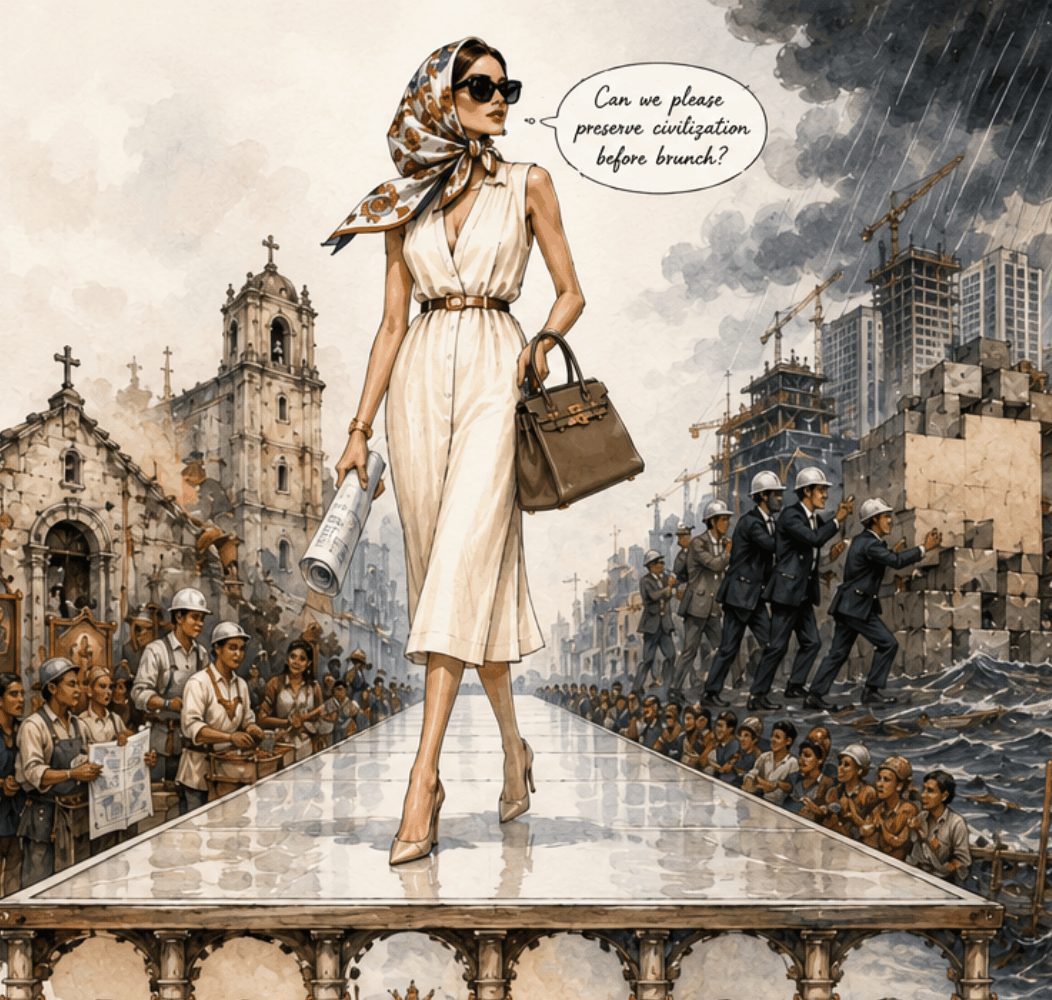
Cebu’s cultural sector has the energy. That is not the problem. We have artists, designers, makers, musicians, chefs, historians, collectors, architects, cultural workers, community organizers, and aunties with terrifyingly accurate memories. Cebu City’s designation as a UNESCO City of Design in 2019 did not invent this creative force. It simply gave international recognition to what had long been true: that Cebu’s culture of making, adapting, exporting, and reinventing is one of its deepest civic assets.
What we still need is coherence. Less confetti, more continuity.
Events come and go. Administrations change. Projects are launched, relaunched, renamed, and occasionally sent to wander the desert wearing a tarp banner. Meanwhile, developers move faster than conservationists, and concrete has never been famous for waiting politely.
The challenge now is not whether Cebu has culture. Ay, please. Cebu has culture in excess. Cebu has culture spilling out of churches, kitchens, ports, factories, roadside stalls, ballrooms, design studios, school corridors, and WhatsApp groups. The question is whether Cebu can organize its culture well enough to protect it, fund it, teach it, modernize it, and let it earn without being stripped for parts.
What we still need is coherence.Less confetti, more continuity.
This is where design becomes useful. Not designed as expensive furniture under dramatic lighting, though we enjoy that too. Design as method. Design as policy. Design as a way to connect heritage districts, mobility, tourism, education, climate resilience, livelihood, documentation, and urban planning into one living system.
The future of Cebu heritage should not be a choice between preservation and progress. That is a lazy binary, usually served by people who have already chosen progress and merely want preservation to stop making eye contact. The better question is: how do we build a city where the old gives intelligence to the new?
Cebu’s heritage is not dying. That would be too simple, and Cebu is never simple. It is vibrant, uneven, underfunded, over-photographed, deeply loved, occasionally neglected, and still magnificently alive.
The state of heritage and culture in Cebu is this: we are rich, but not yet careful enough with our wealth.
So yes, darlings, polish the silver, restore the walls, archive the songs, fund the museums, protect the churches, teach the children, pay the artisans, listen to the elders, and for heaven’s sake, plan the drainage.
Because in Cebu, heritage is not a costume we wear for festivals. It is the house we are still living in.


7 Things You Need To Know Before Watching Balangiga: Howling Wilderness
Scenes From the Manila Art Fair 2026

Retrospective: Oj Hofer Celebrates 40 Years of Fashion

Cebu Isn’t Chasing Trends Anymore
Golden Prince Hotel’s Sinulog Royalty Experience

SM Fashion Forum reveals Cebu’s style influencers
5 Filipino Films That Continue the Conversation on Women Empowerment
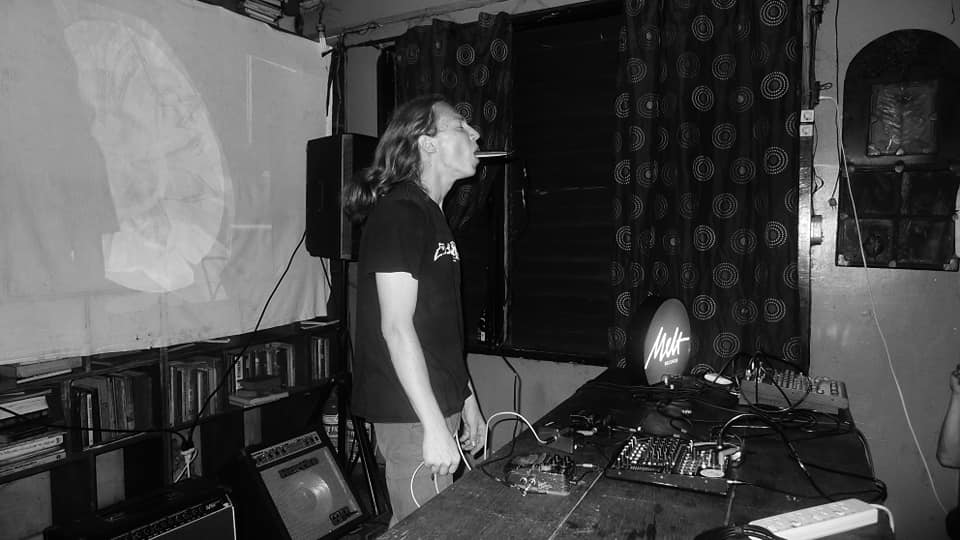
Noise and Sounds: An Artform

Christmas in Colonial Cebu: A Themed Exhibit by Teresin Mendezona and Eva Gullas for Stylescapes 2019

Artisanal Cebu: Aspiring calligraphy artist Abigail Condrado

Experience authentic Korean Barbeque at Da-In Restaurant

Chaine des Rotisseurs: A Night of Spanish Cuisine
-
 Art Beat2 months ago
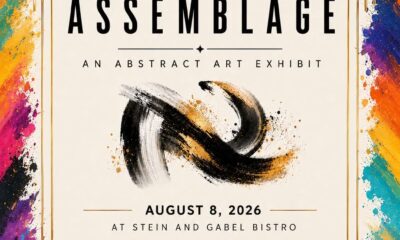
Assemblage: Art Exhibit Blending Themes of Infinity and Renewal
-
 The Scene2 months ago
At the Table: Introducing Flora de Filipinas
-
 Retail2 weeks ago
Cebu Isn’t Chasing Trends Anymore
-

 Art Beat2 weeks ago
Why Does Yayoi Kusama Matter to Cebu?
-
 Fashion4 days ago
Retrospective: Oj Hofer Celebrates 40 Years of Fashion
-
inside3 days ago
Scenes From the Manila Art Fair 2026
-
inside15 hours ago
7 Things You Need To Know Before Watching Balangiga: Howling Wilderness