for the five up-and-coming names in the industry, who he feels will be dressing some big names soon.
photography KODA
hair and makeup JANICE BARILLO And NICKO DELA PEÒA
locale THE PYRAMID
Originally published in Zee Digital Vol.1
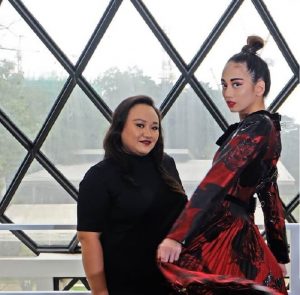
PERCIE LOVE REQUIERO
When did you know you wanted to be a fashion designer?
when I was younger, I fancied clothes, especially those with elaborate details. It started out as a hobby-making clothes for my daughter. It was two years ago when I finally decided to get formal training, and realized that designing is my passion.
How did you break into the industry?
In 2016, my group and I represented FIDA in a competition. Then, more opportunities came.
How would you describe your style?
Tailored, simple and timeless
Who are the Cebuano designers you look up to?
There are a lot of designers that I look up to, especially my FIDA mentors. Each of them has their own expertise that honed me to be where I am today.
What are your plans for 2018?
As a beginner, this year, I want to focus on having more exposure, experience, and to get to know more about the industry. I want to gain additional
knowledge from seasoned designers on how to handle challenges in the business, and at the same time, establish my brand.
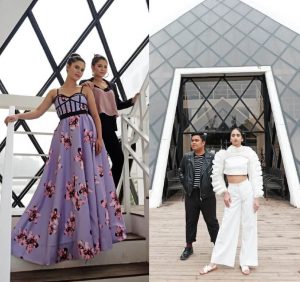
Yoko Sato Li and Edward Castro
YOKO SATO-LI
When did you know you wanted to be a fashion designer?
Ever since I was young, it was really my dream to be a fashion designer, but eventually I forgot about that because of other priorities. My mom wanted me to take up nursing, so I followed her and even got my license. I also worked as a Loans Associate, and a bank teller for almost three years. It went well, but something still seemed missing. I rekindled my love for fashion. I tried to enroll in FIdA several times, but had doubts pushing through since I had a hard time giving up my stable job at the bank. I talked to some of my friends and family, but most of them weren’t supportive about taking the risk. It was my husband who was very supportive, and motivated me to follow my dream. I weighed things, and didn’t want to grow old and have regrets about not pursuing what I really love to do. I then realized that it meant a lot to me, and I fought for my passion and chased my dreams.
How did you break into the industry?
As someone who is still starting in the fashion industry, I think the FIdA Graduation Show Beyond Borders opened me up to a lot of opportunities.
How would you describe your style?
I am actually an eclectic person. I love to mix and match different styles and make it my own. It is important to have an eye for what you like, and what suits you or your client. I tend to like classic
style and go for a minimal look, but I also love trends. I donít really limit myself. I just want to make sure that it looks feminine but edgy, sexy but elegant and sophisticated, simple but unique, and also
clean polished.
Who are the Cebuano designers you look up to?
Cary Santiago, Philip Rodriguez and Harvey Cenit
What are your plans for 2018?
Hopefully starting up my own boutique
EDWARD JAMES CASTRO
When did you know you wanted to be a fashion designer?
Ever since I could remember. For me, what really triggered this love for fashion was watching Cinderella at a very young age. Watching the mice sew her pink dress was something I aspired to do when I was old enough to handle needles and scissors. I would practice draping handkerchiefs on my sister’s Barbie dolls. So I pretty much got into it at a very young age.
How did you break into the industry?
It wasn’t until high school when I started considering fashion design as a career. Before, it used to be only on paper. Being in an all-boys high school made me want to develop my own identity. Most of my peers wanted to be doctors, architects, engineers—I think I was the only one in my batch who showed up for the fine arts college orientation. Fast forward, I didn’t really take up fine arts in college, but I got my big break designing for the college pageants, and winning a few design competitions in school. I met a few established designers when I graduated, and they helped me get into the fashion scene. Eventually I got into Clothes for Life, and since then, I went from this wide-eyed neophyte to a full-time designer and stylist. #DreamsDoComeTrue
How would you describe your style?
My style is very eclectic. I can be at opposite ends of the spectrum. One day I could be fun, nonchalant and colorful. Some days, serious, dark and melancholy. It’s a bipolarity I have embraced with open arms.
Who are the Cebuano designers you look up to?
Cebuano designers are very talented, to say the least, but I have a few whose aesthetics resonate with me a lot. Protacio, for his clean lines and tailoring. Jun Escario for timeless glamour. Cary Santiago for his vision, and how he tells a story with his collection.
What are your plans for 2018?
For 2018, I’m planning to focus more on bridal wear. It’s something I really want to do, but didn’t have time to because of so much freelancing work. I want to develop a bridal line that reflects my design philosophy, at the same time relatable and marketable.
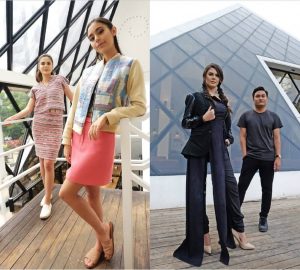
Jessica Ouano and Mike Yapching
JESSICA OUANO
When did you know you wanted to be a fashion designer?
I was always into clothes, ever since I was a little kid—actually costumes to be precise. Halloween was my favorite day of the year, and I loved being in theater because of costumes. I am also very much into cosplay, and I love making things. When I was in high school, I knew that fashion design was something I wanted to pursue.
How did you break into the industry?
My first big opportunity was creating a collection for the Kansai Collection fashion show in Osaka, Japan, with the help of a good friend of mine, Nobuo Koizumi. The collection was a collaboration with another designer from College of Saint Benilde, Jason Patricio. Jason did the designs for the garments, and I worked on the textiles. The project was also how I got into handwoven textiles, and working with the local weaving communities. I was also very fortunate to have been mentored by Oj Hofer for this project.
How would you describe your style?
My style is experimental and quirky. I love garments with simple silhouettes, combined with interesting textile applications. I love experimenting with textiles very much, and I always try to make it the highlight of the garments that I design.
Who are the Cebuano designers you look up to?
I love the work of Oj Hofer, he is such a master at draping. I also love the beautiful, intricate details of the work of Cary Santiago. They are both extremely talented.
What are your plans for 2018?
For 2018, I plan to focus more on experimenting with handwoven textiles, and creating more innovations together with the team at AnTHILL.
MIKE YAPCHING
When did you know you wanted to be a fashion designer?
The love for making clothes came at a young age for me, growing up and observing my grandmother and my aunt, who are both seamstresses. It was during high school when I got obsessed with designing clothes.
How did you break into the industry?
It was in my second year in college when the eighth edition of Mega Young Designers’s Competition was calling for entries. I was fortunate to have been shortlisted from countless submissions. It was a very big platform for me then, as a budding designer, as MYDC was the stage where prominent and renowned Cebuano designers started out, like Edwin Ao, Oj Hofer and Furne One.
How would you describe your style?
I have grown to love evening wear with a minimalist sensibility. Streamlined looks with little details that make for a maximum effect.
Who are the Cebuano designers that you look up to?
Of course, Edwin is always on top of my list. We may have different aesthetics, but the knowledge he has imparted me with are priceless. I admire Arcy Gayatin, Cary Santiago, Oj Hofer and Philip Rodriguez.
What are your plans for 2018?
To live in the moment.
We go behind the scenes and chat up the five young designers we love, preview the stuff they’ve been working on, and ask them to describe their aesthetic.
]]>The question hung over the air after fashion designer and Zee Lifestyle fashion editor Oj Hofer asked the question. The group was gathered in the private dining room of Trattoria da Gianni, enjoying the authentic Italian fare while pondering over their response.
To be fair, there was no assemblage of people who were better fit to discuss the subject. Gathered around the large wooden table were the high council of Cebu fashion, if there was ever any—in attendance were fashion designers Cary Santiago, Philip Rodriguez, Jun Escario and Arcy Gayatin, each an influential figure in the industry; visionary accessories designer Doro Barandino, whose pieces are selling in shops in LA; makeup artist Romero Vergara, who has made over several of the Philippines’ beautiful faces during his long-running tenure; and Eva Gullas, the publisher of Zee Lifestyle, a publication that has been an informal vanguard of what’s going on in fashion for the past 20 years.

Romero Vergara and Oj Hofer
Jun Escario was the first to break the silence with a joking tone: “Naa ba? (Is there any?)”
Everyone bursts out laughing. “Naa uy (of course there is),” both Arcy and Cary exclaim.
Cary pauses and adds, “Actually Jun, that’s the right question. We don’t really see these young designers now. They don’t even do fashion shows anymore.”
Everyone nods at the noticeable difference. Just five years ago, invitation to various fashion shows and events would come in at least once a month, varying from large-scale solo designer presentations, to collaborative shows that bring several names together. In 2012 alone, Zee Lifestyle staged two large ones: Furne One’s fashionable homecoming, a week-long affair that involved jewelry talks, a designer bazaar, and an exhibit; and Jun Escario’s 20th anniversary show that transformed the Oakridge Pavilion into a red cathedral.
THE ISSUE OF FAST FASHION
These days, events like that have been limited to a few every year, and the majority of them have featured the influx of international brands that have entered the market. “I guess the biggest disruptor for you is H&M and Zara,” Eva mused.
“Not really,” Cary argues. “It’s not totally high-end. For example, if you’d pass by Jun’s shop, you really stop and take a look inside. The pieces are unique.”
Certainly individual style suffers to an extent when in the realm of fast fashion. Philip shares, “It doesn’t matter if you go to Europe or somewhere else—if you buy it in Zara, it’s exactly the same everywhere in the world. They’re generic.”
“But it’s amazing how fast they can interpret fashion trends,” Eva points out.
“Ralph Lauren used to be the richest designer in the world, but now?” Arcy shrugs empathically. “You know why? Because Zara is very fast fashion. They can translate what they see on the runway in a couple of weeks. So many designer boutiques have closed down because they can’t keep up.”
There’s no denying, of course, that fast fashion has transformed the landscape of the retail clothing industry. Once editors post their reviews of the major fashion shows—which are practically on the spot now, thanks to the digital age—these brands roll out a massive inventory that boasts the latest insider-approved trends. Asymmetrical collars? Ruffled sleeves? Palazzo pants? If you see them on the runway, chances are you’d see them in H&M two weeks later.
 Naturally, the risk that comes with it is, as Philip mentioned, you end up looking like everything else. I know several fashion-forward ladies who have resorted to thrifting and vintage shopping in the hopes of finding that one unique piece that will set them apart from everyone else.
Therein lies the real value of designer clothing—as Eva points out, “The edge with designers is that they can create something that’s just for you.”
“No Ev, it’s all about the fit,” says Cary. “It’s different when a designer gets to mold it to your body.”
“If you approached a French designer, you can still end up with the same piece as someone because you can only take from the collection,” Arcy argues. “Don’t tell me Karl Lagerfeld would sit down with you and sketch up a dress just for you. No way—no matter how rich you are, you have to take from the collection. It’s just over here that we really sketch, and they can still complain that we’re too expensive.”
CEBU’S FASHION INDUSTRY
The statement brings up another issue that young designers face. Although the city is home to a number of truly stylish individuals, the collective level of appreciation for fashion isn’t yet what it should be. As Jun mentioned in last year’s tete-a-tete, “In Cebu, no one is fiercely fashionable. Women dress for comfort.”
That climate is what young designers face when they want to break into the fashion industry. According to Edward Castro, the magazine’s resident stylist and a professor at the Fashion Institute of Design and Arts in Cebu, the pool of talent is considerable. “It’s an eclectic bunch, for sure. They come from different walks of life, they have different styles, but they all have one thing in common—raw potential.”
“I see the fashion industry as a community of creatives who are working individually on their respective brands,” adds Bree Esplanada, who has dressed blogger Ixa Perez, Queen Philippines candidate Trixie Andrews, among others. But he admits to finding a caveat. “However, if the industry really exists, it is mainly favored towards designers with strong social connections.”
This might be the reason why some have chosen to pursue a career in Manila instead, where they feel people are more receptive to conceptual design. “The industry in Cebu is fixed with established aesthetics and standards that can’t be shook anymore,” says Yves Camingue, another former Zee stylist who went on to be a contestant on Project Runway Philippines. These days, his cool street-style collections have been seen on local celebrities and various fashion spreads. “In Manila, there are different strokes for different folks. One can discover his niche and potential in Manila.”
Edward begs to differ though. “Personally, I think Cebu is very embracing and nurturing of new talents. I’m happy to see some of my students already getting clients on a regular basis. That just goes to prove that the Cebuano community can be a progressive community,” he asserts.

Jun’s sister Ixa Escario agrees that though there may be less opportunities, this can actually help in developing their unique identity as a designer—on her end, she’s chosen resort wear and swimsuits as her bread and butter. “I get my inspiration from this city—how it has evolved and grown over the years. It’s underestimated, but never overrated,” she shares. “You have to start from the bottom and work your way up to show what you’ve got. As my city grows, I grow together with it.”
THE CITY’S NEW CROP
So although there is a small exodus of talent, Cebu has a creative pool deep enough to constantly produce someone who could become the next big thing. Which leads us back to Oj’s question: who is the most promising young designer?
“Jul Oliva,” Cary offered up, to which Jun adds, “Yes, she’s very experimental.”
A former protege of furniture designer Kenneth Cobonpue, Jul Oliva had learned to sew as a teenager, but started out with product design before she decided to pursue a career in fashion fully. It might have turned out to be a good step—the alternative aspect of design, and the tutelage of an internationally renowned creative, expanded her imagination. Jul’s designs are certainly forward-thinking. From creating an intricate hand-woven pattern with fabrics for a modern take on the terno, to a shaggy shrug in contrasting colors, the unconventional take on materials and play in texture make each Jul Oliva creation a true conversation piece.
Arcy gives her own vote, “I like Mike Yapching.”
With his own polished take on modern dressing, Mike Yapching had been chosen as the Filipino contender for the Singapore-based fashion competition Audi Star Challenge in 2011—at the time, he was still in the middle of finishing up his studies. Since then, he has been churning up sophisticated party dresses under his eponymous line, and creates ready-to-wear pieces for an international brand based in the Mactan Export Processing Zone.
It’s a consideration that Mike doesn’t take lightly. “Some of the greats in the Philippine fashion industry come from Cebu, and it is such an overwhelming feeling to be considered by them as one of the most promising Cebuano fashion designers. It is an honor and a privilege to be mentored by one of the Cebuano greats, Edwin Ao,” he shares. “I am flattered, yet there is the pressure to always deliver and live up to the expectations of such amazing and inspiring people. I could only hope to become one among them in the future.”
Moving on, Cary adds, “There’s also Celine Borromeo.”
Another alum of Project Runway Philippines (she made it into the top three of her season), Celine Borromeo advocates classic feminine dressing with a twist—oversized blazers and feminine silhouettes done in tweed and pinstripes play up on androgynous style. The designer had taken up a position on Josie Natori’s team, and is now based in Manila.
“I’ve worked really hard to build my name in the industry, and I don’t intend on stopping anytime soon. It is not easy to be recognized, especially if you are a simple designer like myself. I don’t do avant garde. I don’t stand out in that way,” Celine explains. “But what I do is make very polished, classy and modern pieces people of all ages can appreciate. To be able to stand out and be recognized for what I do best by Cebu’s most prominent designers means I’m on the right path.”
A COMMUNITY OF CREATIVES
It seems like the challenges that up-and-coming designers face have an upside—talent and drive are completely different things, and the people who do not persevere in pursuing the profession could likely give up in the face of limitations. In the end, we’re left with talents that we can truly call promising, the ones who took on the arduous road with a fervor that matched their creativity.
For his part, Mike sees the competition as something that helps him work harder. “In my years of working in Cebu as a fashion designer, I can say that, with a little push and maximum determination, Cebuano designers and brands could become globally competitive.”
Edward certainly thinks so when he observes the students year after year. “With a bit of time and accumulated experience, and of course unwavering passion, they will be able to find their own voice and rightfully take their place in the industry,” he shares. “The fashion industry is tough, and it’s crucial to earn your stripes before anything else—it’s hard, but not impossible.”
All that said, the dinner with our high council of designers ends on a hopeful note, that the formidable conditions of the Cebuano fashion industry can help mold a new crop of talent that in itself can be the collective next big thing. To those hoping to rise above, Oj offers three pieces of advice: “Know your product—bring something that has your imprimatur to the fashion design world. Don’t just copy, acquire the skills to be a competent designer. Do the dirty work, don’t just draw. Recognize your strength and weaknesses, and build your own unique aesthetic.”
Second, “Have a specific vision—more than having a fashion philosophy, what is your vision? Be clear about who your clients are and where you want to take your business,” Oj continues. Lastly, “Work on realizing that vision—success in fashion means 1% inspiration and 99% action. Act on your vision until it becomes a reality.”
To simple answer Jun’s question: it might take some looking into, but the promising young designers are definitely out there—naa jud diay.
]]>