By: Allain Dumon Fonte
The brand Arcy Gayatin gave the Queen City of the South a distinct reputation in the fashion industry. The fashion line of Arcy Gayatin sets the bar higher each year for clothing luxury and fabrication techniques.

April Duenas, Nikki Gayatin and Arielle Gayatin for Arcy Gayatin—Photos by John Paul Autor from Lifestyle Inquirer.net
Araceli “Arcy” Ancajas Gayatin is the daughter Galileo Ancajas and Remedios Zanoria Ancajas who founded Cebu’s home brand, Gal’s Bakery. Arcy went to the University of San Carlos and studied Political Science. And just like Dr. Muccia Prada, who completed her Ph.D. in Political Science and established the luxury line of Prada, Arcy also got in touch with her artistic side and started her own fashion line. However, it was not Prada that influenced Arcy. Arcy was introduced to fashion and tailoring at a very young age by her mother, Madame Remedios Anacajas whom they dearly call Mama Eme. Mama Eme was running a tailoring business back then. It was called Arabel; named after Arcy and her sister Belma. Ara from Araceli and Bel from Belma. In those years, Arcy was fascinated by fabrics and was intrigued by how to manipulate the fabrics to come up with fashion-forward designs without compromising comfort and taste.
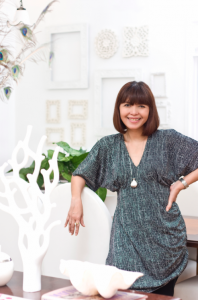
Arcy Gayatin (photo grabbed from Space Philippines Blog Spot)
After 37 years of creating haute couture pieces for the most fashionable personalities in the Philippines, Arcy Gayatin is now laying down her sketchpads and pens to rest. As she enjoys her retirement, may be on a cruise to the Bahamas or a holiday to the Swiss Alps, Arcy Gayatin has left the fashion industry a legacy of elegant and edgy clothing ensembles that understand and define the shape of women; without compromising comfort and good taste.
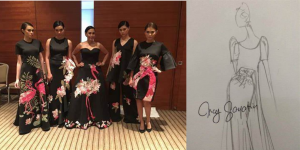
Arcy Gayatin’s Pink Flamingo collection Arcy Gayatin’s Sketch on a Terno
To salute the lady who brought Cebu fashion to the world, a retrospective exhibition of Arcy’s incomparable masterpieces can be seen today at Ayala Center Cebu’s The Gallery; curated by fashion editor and writer, Clint Holton Potestas, and interior and fashion designer, Jul Oliva.

BALANCE. Arcy Gayatin is known for her perfect symmetrical lines when fabricating. She knows how to balance edginess and class; understanding well the strength and the finesse of a woman.
RHYTHM. Arcy’s expertise in draping and fabric manipulation can be seen in how she achieves rhythm between architectural lines and soft fabrics like silk and cashmere.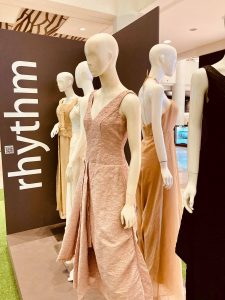
TEXTURE. With her thorough knowledge on fabrics, Arcy Gayatin has achieved the perfection of fabrication by working on different types of fabrics and creating a single piece of art out of them. 
HARMONY. The simplicity of the silhouette plus the intricacy of the details create a wonderful harmony, making Arcy Gayatin’s design a one-of-a-kind masterpiece.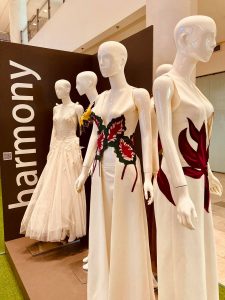
The photos below show an up-close look at the intricacy and the exquisite craftsmanship of Arcy Gayatin’s fabrication techniques:
 THE SPIDER WEB: one of Arcy’s genius fabrication techniques.
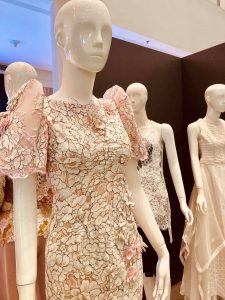 MATCH and PATCH: Arcy’s unique fabrication craft by patching layers of different types of lace and lace patterns
 PLEATS: The perfection of symmetry in pleats on silk.
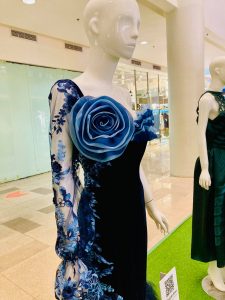 LA ROSE BLEUE: U.P. student, Danielle Alessandra Deutsch, inspired by the artistry of Arcy Gayatin, designed this midnight blue dress. The cabbage rose made from layers of silk organdy gave this evening ensemble a romantic appeal.
Food is at the heart of Cebuano culture. With eateries everywhere, as this city becomes more progressive, so does our cuisine. The island’s resources and the fact that it is a hub city in the South have given the people more than enough room and reason to explore cooking. Over the past decades, they have gone the distance, beyond perfecting roast pork to world renown. There are now a lot more local restaurants serving up items that I’d daresay would be quite competitive on the international culinary stage. From traditional recipes to exciting newfangled items, and from veritable kitchen science experiments to home-cooked simplicity, the breadth encapsulates Cebu’s diversity, tossing in what’s local with some global influence to simmer tradition and fusion in a big pot of delicious.
The Cebuano is notoriously hard to please, fickle, either always on the lookout for what’s new or extremely devout to their inclinations. We’re constantly shifting through the new kids on the block, hopefully seeing beyond distracting thematics, and zoning in on what’s damn good. There is always a handful of must-try food items anywhere that both represent the essence of the city and gives you a taste of its times. Here are five of my personal favorites that anyone visiting Cebu must try.
Originally published in the Zee Digital Vol. 1. To get your free copy, click here!
]]>“I’m probably the friendliest graphic designer you’ll know,” PJ Ong says as we were wrapping up after the shoot at the villa of Crimson Mactan Resort and Spa. I had asked him what it was that he felt made him stand out from other artists, and he’d replied his character.
Definitely easygoing, PJ is the man behind Indoro, his creative signature that had received widespread recognition for being the Filipino artist featured in a Uniqlo collection. “It was a great pleasure collaborating with Uniqlo for their Feel the SEA campaign,” he said smiling. “I’m still overwhelmed with the positivity that a team of highly esteemed curators chose me to represent the Philippines.”
It’s not unusual for someone to ask why PJ had chosen Inodoro as his brand name, considering it is the local word for a toilet. “I wanted a name that had Filipino-Spanish roots, with hints of controversy and humor. Embracing the punk ethos, my moniker naturally has a streak of rebellion and non-conformism. In short, a Fuck You attitude. Plus, it’s hard to forget.”
Inodoro is entirely abstract and experimental design. PJ stressed that each project is a unique endeavor, but he always tries to stay true to his design DNA. His work emphasize his principles, which are rooted in being forward-thinking, through-driven and dynamic.
This is an excerpt from the Zee Digital Magazine Vol. 1. To read the full story and get your own copy, click here!
]]>
Despite it being a day for family, Christina and Duke Frasco gamely accepted our Sunday-scheduled photo shoot. Not that they had any choice, considering that most days found their schedules fully packed.
The dynamic couple is hard to pin down for a reason. Christina is the mayor of Liloan, a first-class municipality in Cebu. On the other hand, Duke was appointed Cebu Port Authority Commissioner by President Rodrigo Duterte just last year, willingly giving up his position as Liloan’s vice-mayor alongside his wife. While they have a lot on their plate because of work, having three young children is an added responsibility.
The Love of Liloan
Goal-driven and full of ideals, the couple has helped develop Liloan into what it is today. The municipality is one of the most progressive in Cebu, even establishing the Liloan Lesbian Gay Bisexual Transgender (LGBT) Federation during Christina’s term, the first in the country spearheaded by a local government unit. Liloan prides itself in having the first LGU-established gender-neutral public restroom in the country.
“Our dream is to become a city,” Christina divulges. She envisions Liloan as an ideal place to live, study, work and invest. “In preparation for that, we are focusing on improving public infrastructure, opening up and improving road networks, and ensuring strict compliance with our Zoning Ordinance and Comprehensive Land Use Plans to ensure that development is regulated, deliberate and sustainable.”
This year, Liloan is launching tour packages that will feature its cottage industries and various tourist sites. Health services are being professionalized, scholarship programs expanded, and more investments channeled into its law enforcement and disaster response programs.
“We are also enhancing our community governance programs focused on protecting the environment, providing economic opportunities through livelihood, and reaching out to all sectors and stakeholders by incentivizing participation and compliance with our laws and regulations,” Christina adds.
Duke shares that every now and then, he offers input to his wife. “I advice Christina on various matters, especially regarding the projects started during my term, such as our scholarship program and purok system,” he says. “Being the party chairman of our local political party, I am also in continued contact with our local leaders.”
A Great Pair
It’s evident that the two make a great pair. They met back in June 2007 at Gwendolyn Garcia’s—Christina’s mother—inauguration as the re-elected Governor of Cebu. Duke was among the officials invited to attend, having just been elected into his first term as the Mayor of Liloan. Christina had just recently passed the bar exams and became a lawyer.
“I suppose you could say that we met at a time when both of us were at a turning point in our lives,” Christina recalls. “It is a blessing that our paths crossed at a time that it did. I was taken by Duke’s charisma. To me, he exuded kindness and humility. Of course, bonus sad gyud na guapo kaayo siya (it’s a bonus that he’s so handsome)!”
“I thought she was beautiful, elegant and well-spoken,” Duke adds. “When we were introduced, I was speechless!”
They’re naturals in front of the camera, effortlessly settling into the poses the photographer asks them to do. At one point, they’re locked in an intimate embrace and looking into each others’ eyes. Duke sweeps in for a kiss that makes everyone in the studio coo.
“I couldn’t help it,” Duke defends himself with a laugh, holding Christina closer as she giggles.
“He can’t resist me,” she tells us with raised eyebrows.
This is an excerpt from the Zee Digital Magazine Vol. 1. To get the full story and your own copy, click HERE to subscribe now!
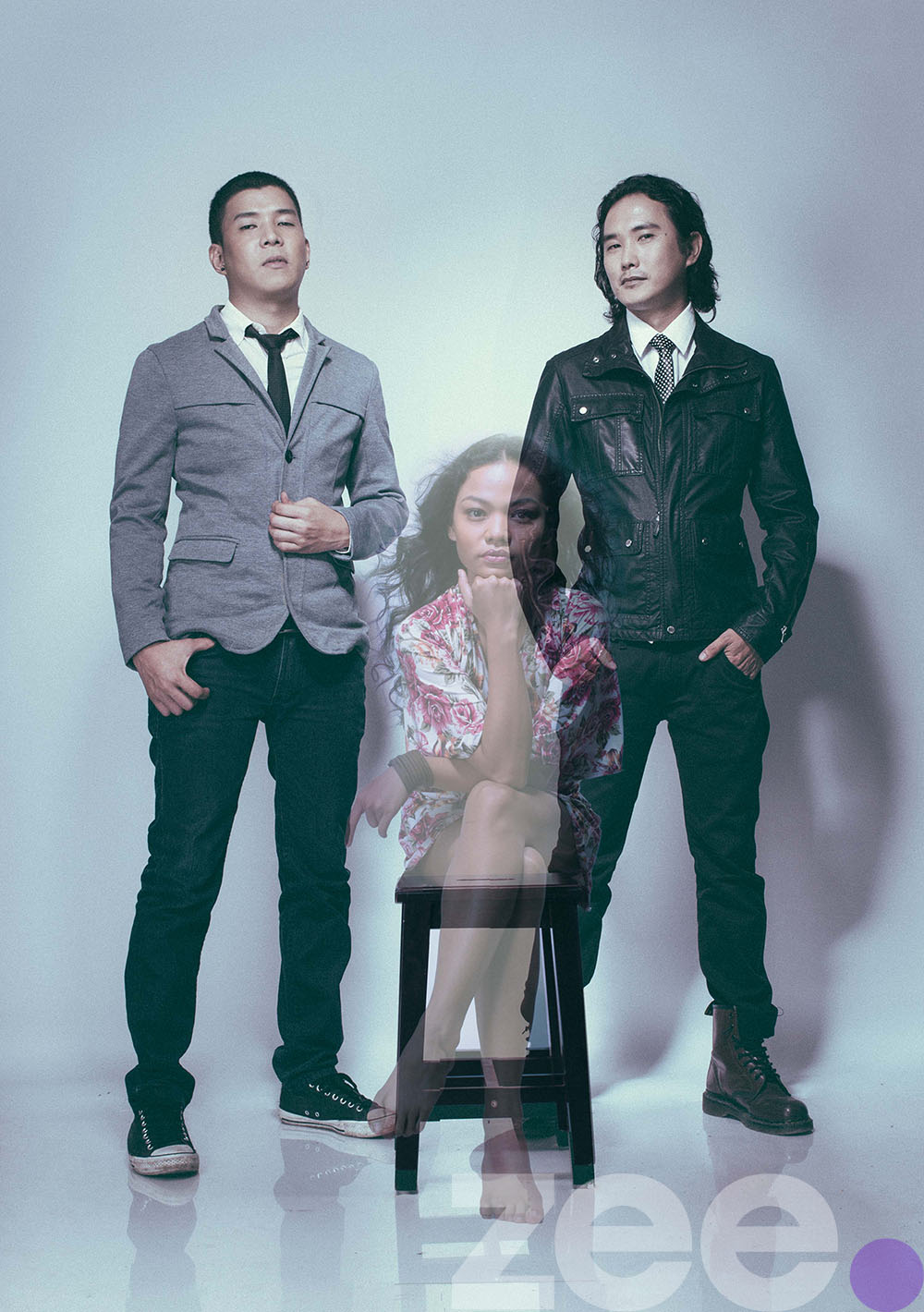
]]>Going in, she knew it wasn’t easy to live the life of an artist, but Chai says music is not a hobby but a worldview. To advance her creative endeavors, she quit a high-paying job and gave up on others things that pulled her away from her passion. And like life’s sweet reward, she now reaps a sense of fulfillment as the vocalist of the band Womb, where she is able to do what she does best. Technically, Womb’s music is electronic down tempo, but Chai and band members Anthony and Fender fondly call it “sleepy music.”
Who are the Cebuano artists you want to work with?
I’m not one to easily work with other people because that requires chemistry—it’s all or nothing. A lot of it is also my insecurity over having relatively limited skills. Also, liking another act or artist doesn’t necessarily mean you can work well with them. But I like a number of the local acts here in Cebu; I even bought their albums. Apart from Womb, I am currently able to work with a number of artists and writers whose work I like under the 22 Tango Records label, as well as the writers’ group I started.
What do you love about the Cebu music scene?
The fact that I think it has begun to wake up again. I hope it stays awake forever and does not drift back to sleep like in the past years. That takes a lot from the local community though—both artists and audiences.
What’s your most memorable performance?
We haven’t had too many performances (not too many places have sound systems that accommodate our set-up) but the one at Cattski’s Zero album launch in Harold’s Hotel was awesome. Everyone was chilling and sitting with us on the floor, silent and listening.
What is your dream job?
To be able to live on the things I do best—music, acting, writing, and not having to wake up in the morning to work!
What do you love about writing?
It’s a sandbox. I can’t animate, so I write them. I can’t draw, so I write them. I can’t dance, so I write them. I don’t know how to make actual sand castles or climb trees, but I can write about them. I want a sentient paper crane, so I write it. Some friends need some form of closure, so I write their stories for them. Also, reading and writing teach me empathy, tolerance, and understanding. It’s also brain exercise.
Where do you usually hang out?
A kooky little spot called Turtle’s Nest along Gorordo Avenue. It’s my home base of sorts.
Are you in a “happy” place?
Yes and no. With music, I’m still working very hard to get where I think I should be. But I like it that I am fighting my way out of being lost and being led further away from my personal creative endeavors.
Describe Chai Fonacier as a friend.
I’d fight for a friend and go to random beach trips with them.
What keeps you busy when you are not performing?
My day job and finding money for music, theater-related endeavors and side projects for rent and meals. The chores and meetings. Also, cat responsibilities since I have two cats that I kidnapped off the street when they were little. They’re currently very happy and lazy. Aimlessly wandering in search of books or dirty ice cream, too.
What’s the greatest sacrifice you’ve made for music?
Acceptance of the fact that I had denied my very self by allowing all these debts-to-self to grow out of proportion. So after a work-related trigger made me say ‘I’ve had enough of these toxins,’ I quit and suffered a financial crisis in the process. I strained a few relationships and am crawling through this long ordeal so I can clear my head, recharge and produce material using the tools that I’d been given, or that I’d acquired. I can’t do anything about what I was given—I could have been given math, but I quite naturally possess no genes for it. Music to me isn’t happy; it shapes my worldview. I communicate with it when talking no longer suffices.
Some people misunderstand this. I can have a day job and various companies on my resume, but music is a constant and not just some minor thing that I do during my leisure time. It’s even given me skills that I use in my day jobs, so for some to consider my music as a side dish is an insult.
It’s offensive to many artists who create work that help audiences approach and understand their own truths when they need to. Simply put, we feel and experience and understand extremes for those who don’t have the time so because my heart is mostly dedicated to my creative endeavors, I would rather say that I am a musician and have a day job on the side. Sorry, I get really rabid about it.
What is your dream project?
Wow, I haven’t really thought about that—we’ve just been concentrating on finishing the album. I guess apart from the current projects, I’d like to be able to publish a book of short stories as soon as I’m sure they’re well-baked, for one. Create installation art pieces that I’ve been talking about forever with one of my best friends Russ Ligats (who is a visual/performance artist) but I must find money first. Gaaah, why is this so hard?
Do you have a mantra?
Not really, but whenever I feel that I need to play cheerleader for myself to get things going, I scream ‘banzai!’ and then I play my mental war drums.
Any plans for future or upcoming projects?
Womb is releasing a single for March, and the album will be out this summer under the Cebuano label 22 Tango Records. Future plans for a solo album, and a second album for Womb. Theatre projects with a few friends that I can’t divulge details as of yet, and more projects with a group called The Really Bad Poets.
Originally published in Zee Lifestyle magazine.
]]>Its inauguration celebration was attended by President Rodrigo Duterte, and a number of prominent Cebuano personalities who were all curious about the new terminal. It officially opened its doors on July 1, and has since seen the opening of a number of new direct routes.
Touted as the country’s only resort airport, the MCIA Terminal 2 is a lifestyle destination all its own. The design is a collaboration between the Hong Kong-based Integrated Design Associates, and top Filipino interior design and architecture duo Budji Layug and Royal Pineda.
The terminal features a series of 15-meter high arches that evoke the image of waves, a fitting homage to the seas surrounding Mactan Island. Supplied by the European company Rubner Group, each arch was shipped in one piece and created with wood from a sustainable supply.
More importantly, the new terminal will also serve to highlight local Cebuano talent—world-renowned designer Kenneth Cobonpue is coming in to create pieces for the interiors, while celebrated fashion designer Cary Santiago designed the airport’s staff uniforms.
On his end, Kenneth is excited to create a world-class terminal with his frequent collaborators Budji Layug and Royal Pineda, and believes the design will make history.
“We are hopeful that this is going to be the best airport in the country.”
The aesthetic elements aside, it’s clear that efficiency was a top priority in coming up with the design. A two-level forecourt segregates the Arrivals and Departures area. There are 48 check-in counters, which are expandable to 72, and provisions for seven passenger boarding bridges. It’s also equipped with 12 escalators and 15 elevators, facilitating the easy movement of passengers, especially persons with disabilities.
To further enhance customer service, there will be a premium lounge at the International Departures area. Passengers who are either leaving or coming can enjoy a number of in-terminal activities, or visit the new retail and dining concepts. There’s even the option of enjoying Cebu’s famous lechon in one of the stalls at the terminal.
Although it’s not yet functional in its entirety, and we hear there are processes that need to be streamlined, we’re extremely proud to have such a monumental gateway in Cebu. Its towering facade of curves and glass is a promise—one of progress, development, and bringing the rest of the world a little closer to home.
This is an excerpt taken from the Zee Digital Vol. 1. To read the full story, download your copy now at www. zee.ph!
]]>
“The GT-R is Nissan’s iconic super sports car, and is the epitome of our brand promise of bringing ‘Innovation that Excites’,” says Ramesh Narasimhan, Nissan Philippines Inc.’s (NPI) President and Managing Director. Having flown in for the Tour’s festivities, he drives the GT-R with the ease of someone who understood the craftsmanship behind the hood—something to be expected for someone at the helm of Nissan’s Philippine operations.
Of course, there’s more to Nissan than just the GT-R. With Jukes, Urvans and especially Almeras steadily rising in numbers through the years, the Nissan brand has cemented its presence on our roads. This may be largely thanks to the establishment of Nissan Philippines Inc. four years ago, creating a local base for the global brand and consolidating their operational efforts in the country.
“While the Nissan brand is not new to the Filipinos, our company is still quite young,” Ramesh explains about NPI. “We have only been operational in the country for four years, and during this time, we have been setting the foundations to build and strengthen the brand. Now that we are in that position to truly give the brand a push, we are excited to offer a wider range of innovative vehicles to cater to a highly intelligent automative market.”
Models like the spacious Urvan, the tough Navra pickup, the economical Almera, and the stylish Juke have all gained a following in their respective. “It’s very difficult to choose just one,” Ramesh says when asked if he had a personal favorite in the Nissan lineup. “My favorites definitely include the Nissan GT-R and Patrol Royale. In Japan, I had the chance to drive the Note E-Power. It’s a small car, but because of the technology behind it, it delivered a very exciting and exhilarating drive.”
Nissan currently has 34 dealerships in 31 cities around the Philippines, three of which are in Cebu. “Our three dealerships are spread out in Cebu—one in the north, one in Cebu City, and one in the South—to cater to the growing market, and expand our reach in the region,” Ramesh shares. Nissan Maguikay in Mandaue City, headed by Julie Tio, has been in operations for years, while Charles Sy’s Nissan Central in the North Reclamation Area, and Markane and Michael Goho’s Nissan South in Talisay opened one day apart earlier this year.
“At the end of the day, the objective is to grow the Nissan brand in the Philippines, and with the support of these three dealers, we believe that we can achieve this goal,” Ramesh continues.

Ramesh certainly seems like the perfect fit for his role atop the company. A gradate of Commerce and Cost and Management Accounting in India, he had moved to Australia to finish his Masters of Business Administration at the Monash University in Melbourne. From there, he worked in finance for the Ford Motor Company for ten years, before he took on the role of Chief Financial Officer in Nissan Motors Australia.
“During that time, I was fortunate to have had a number of different roles that helped me deepen understanding of the business and automative industry as a whole,” Ramesh shares of his past experience. “Having a strong background in Finance has definitely helped me in my current role as NPI’s President and Managing Director. Being able to understand the company’s financial situation ensures that were growing profitability in a sustainable way.”
When the opportunity to move to the Philippines came up two years into his tenure, though, Ramesh thought it would be a great change. “I was eager to move to a more general management position to broaden my view of the organization. So when this opportunity arrived, I was more than willing to take it,” he admits.
These days, Ramesh oversees the company’s operations in the Philippines, and works with his team in creating a vision for the organization and developing strategic plans that will help achieve that vision. “These include plans to expand our business, grow our market share, and identify potential growth segments for the brand,” Ramesh explains. “But the most important part of my job, I believe, is to ensure that we have a highly motivated team who would put those plans into action. I enjoy getting to know the employees, and what they need in terms of support and training, because a strong, passionate team is what will bring Nissan to the next level.”
The conscious effort to focus on the team is something to note, considering Ramesh believes the best part about the Philippines is its people. “Filipinos are so hospitable, friendly and welcoming. I have felt very at home here, since day one,” he admits. “I enjoy the family-like atmosphere show, as well as their love of food and music. These, along with the vibrant market, make the Philippines a very attractive place to live in.”
Part and parcel to the job is traveling to different parts to the country on business, bringing us back to the day of the shoot. He stands next to GT-R, looking dashing in a Ricardo Preto jacket that matched the sporty feel of the car. “This particular model, which is the vehicle’s latest iteration, features between ‘GT’ or Grand Touring, and ‘R’ or Racing. This means that it is the most comfortable GT-R ever made, yet does not compromise its driving performance,” he told us. “It was launched here in the Philippines in 2016, during the fifth Philippine International Motor Show, and has been making waves in the market ever since.”
Even in its older models, the GT-R is certainly iconic, but Ramesh explains that elements of the car’s aesthetic is also present in the other models in Nissan’s lineup. “In terms of looks, our vehicles carry specific design elements that give them a distinct Nissan style and allow them to stand out on the road,” he says. “In terms of technology, we are beginning to bring in Nissan Intelligent Mobility in the Philippines, starting with the new Nissan X-Trail. Nissan Intelligent Mobility, or NIM, is a comprehensive set of features that makes driving safer and more enjoyable for the customer.”
Displaying the full power and features of the NIM was the recently launched Nissan IMx at the 45th Tokyo Motor Show this year, promising a better driving experience by creating a better connection between you and your car. The NIM has features that can only be defined as the future of driving—the Intelligent Forward Collision Warning, which watches two cars ahead for accident prevention; the Intelligent Blind Spot Warning that alerts you to vehicles in your blind spots; the Intelligent Lane Intervention that keeps you from drifting out of your lane; the Intelligent Back-Up Intervention that checks for vehicles behind you and automatically brakes for things you can’t see; the Intelligent Around View Monitor that gives you a bird’s eye view of your surroundings; and the Intelligent Distance Control, which ensures you’re following other cars from a safe distance in traffic.
Certainly impressive in itself, the NIM is packaged in stylish, contemporary vehicle shapes that show how Nissan brings together beautiful aesthetics and innovative technologies for a ride that’s like no other.
“Innovation that Excites,” Ramesh reiterates the brand promise as he gets in the car to reposition the GT-R into another photo-op spot. With everything coming up and Ramesh behind the wheel, it seems inevitable that Nissan Philippines Inc. is set on delivering that promise.

Julie Tio
Nissan Cebu Mandaue
ML Quezon Avenue, Maguikay, Mandaue City
photography Ezekiel Sullano
makeup Romero Vergara
hair Jesse Egos
What made you choose Nissan as a brand to bring into Cebu?
We have the unique distinction of being one of the oldest Nissan dealers in the Philippines, with our partnership beginning in 1993. We are also one of the few dealerships in the country that distributes Nissan exclusively. This longstanding partnership has bred a culture of loyalty, not only between our group and Nissan, but with our customers as well. In fact, we have had customers in the past whose children are our customers now. This is a testament of the Cebuanos trust in the Nissan brand. This kind of personal relationship between Nissan and our customers keeps us going, and inspires us to do our best to serve their requirements

Charles Sy
Nissan Cebu Central
A. Soriano Avenue, North Reclamation Area, Cebu City
photography Mark Philip Dales
What made you choose Nissan as a brand to bring into Cebu?
Nissan has always been on the forefront of automative technological innovation. For example, Nissan is the world’s first EV (Electric Vehicle) mainstream manufacturer. They are currently number one in EV sales worldwide. It is for this and a whole lot of other reasons that our group, The Autocentral Group, decided to carry Nissan in our brand lineup. Nissan is synonymous with innovation, quality and durability—these are the qualities that make Nissan an integral part of our company.

Michael and Markane Goho
Nissan Cebu South
Highway Linao, Talisay City
What made you choose Nissan as a brand to bring into Cebu?
We chose Nissan because we have a strong passion for the brand and everything it represents. We see so much potential with Nissan in the Philippine market. Nissan offers a lot of promising and exciting new products that will delight our customers. We also admire the brand’s strong emphasis on the importance of Customer Experience, as this is also a central direction for our group.
Nissan chose us because the direction of both our companies are very much aligned. We share many values and commonalities.
]]>
“I imagine people assumed we would be building a budget business hotel, because this is the offering we first put forward with the Iloilo Business Hotel,” president Angelli Suzanne Lua-Domingo says, referring to the family’s other venture in hospitality. “But we decided to keep the details of our Cebu offering a secret, and open with a surprisingly new concept that would really stand out in Cebu.”

As president, Angelli Lua-Domingo strives to provide world-class facilities with a touch of Cebuano hospitality.
Having overseen the hotel’s growth from its conceptualization to the current operations, Angelli is the president of the Bai Hotel brand and one of the scions of the decidedly private family behind a reputed Cebuano brand. Branching out into hotels may be something new for the company, but Angelli feels that she had been, in some way, preparing for it her whole life. “I took up Hotel and Restaurant Management in University of San Carlos, so I have some educational and practical experience in this field,” she shares. “In fact, I interned at Marriott for a short stint, and gained a great deal of hands-on experience. Plus, I always try to gather as much information as I can from the different hotels we stay at when we travel.”
“I had always wanted to open a small boutique hotel when I finished school. I would save photos of hotels and restaurants for inspiration,” Angelli continues. The family’s property in North Reclamation Area was a great place to turn that dream into a reality, but she later realized that it was time to dream a little bigger. “The property was more suited for a larger project and offered us a wider canvas to build.”
There’s something that’s certainly impressive about Bai Hotel’s final iteration. Created by the Singapore-based architectural firm A+P Group, lead by Head Architect Liew S. Shoon, the 23-storey L-shaped building features perforated metal panels and columns over glass in an amalgamation of sorts between brutalist and art deco architecture. “We wanted a facade with more glass than traditional hotels, to have more of the abundant sunlight we are blessed with here in Cebu, and a color scheme that would stand the test of time,” Angelli shares.
“Cebu is a fast-growing tourism destination, and we are very fortunate to be placed in the center of much of that growth. I predict this area will only further grow in popularity, and more and more players will be opening up their doors—and I think that’s great! A rising tide raises all boats, as the saying goes.” – Angelli Lua-Domingo
Sustainability is also something that was taken into consideration for the hotel’s design. “We are the first hotel outside Metro Manila that goes green,” explains Alfred Reyes, the hotel’s General Manager. “Bai Hotel’s building is covered with a glass called a low emission double-glazed panel glass, which saves 30% electricity.”
Inside, the lighting is warm and the fittings luxurious—the high ceilings are further emphasized by wooden panels that stretch up five floors, while the marble flooring and grand staircase add a tasteful touch of decadence. “We approached someone local for the interior design,” Angelli says, referring to Stefan Dy. “I felt that he was really able to capture the bright and classic feel we needed for the large spaces on one hand, and putting together a cozy guest room experience on the other.”
Bai Hotel’s is example of understated luxury, with relatively simple design elements coming together in a truly sophisticated space. “The luxury you feel actually originates more from our approach to the fine details. Instead of buying expensive European furniture or lighting, we actually sourced most of our furniture locally in Cebu, and we implemented a lot of cost-saving measures,” Angelli explains. “We use natural air cooling in the hallways, water conservation sinks and toilets, along with other eco-friendly technologies.”

The rooftop pool is one of Bai Hotel’s distinguishing features–the sweeping view of the city makes for scenic lounging.
The decision to include local touches to the experience is something deliberate—Angelli and the rest of the Bai Hotel team believe that celebrating the Cebuano heritage is something that will set it apart from everyone else in the market. Here, the staff greets guests with a warm “maayong buntag!” (good morning in the local dialect), and a hand over their heart. “It’s a homegrown offering. We value this deeply because we share a certain connection and pride to be serving our fellow Cebuanos,” she shares. “The name itself is even a local term of endearment.”
Helping Bai Hotel offer the best possible brand of Cebuano hospitality is Alfred, the hotel’s Vice-President for Operations and General Manager. With international chains such as the Four Seasons, the Hiton, Linden Suites and more under his belt, Alfred’s illustrious career in hospitality had begun at the Cebu Plaza Hotel in 1988.
Now back home after stints in Manila and abroad, he believes that Bai Hotel’s opening is a momentous one for the local industry. “Bai Hotel will be the first hotel in the Philippines that is opened by a Filipino and has more than 600 rooms. In Metro Manila and most parts of Luzon, only expats are selected to open such a big property,” he reveals.
“We’ve evolved from traditional customers to more dynamic and demanding travelers,” Alfred explains about the changes in the hotel industry since he first started almost 30 years ago. Having come aboard the project in the early days, he was very involved in training the team to develop Bai Hotel’s signature brand of service. “Opening a hotel is never easy. It is a given fact that there are always birth pains. During a soft opening, there will be still be glitches, and adjustments have to be made. There is always something that will need improvement. It is also important that the staff are open to suggestions in improving the hotel system and practices to provide the best customer service.”

At the lobby lounge, the attention to detail in design is clear, as the lighting fixtures mimic the tile pattern on the bar.
Angelli reiterates the importance the staff plays in the hotel’s success. “Our customer is our number one priority and we value them deeply, so to ensure a pleasant stay with us, we must be committed to the highest levels of quality and service. That service begins with our people,” she says. “All members of the Bai Hotel staff undergo a rigorous training program to know the ins and outs of our hotel, and to be prepared to attend to our guests’ every need. We also periodically hold special training seminars to further their improvement and build up new skills. I feel you will find our staff to be one of the most attentive in the industry.”
Bai Hotel’s quality of service and amenities is further cemented by their partnership with Worldhotels, a group of independent hotels around the world. “It’s a tremendous partnership for us. They share our dedication to detail and commitment to customer satisfaction, and they also share a strong desire to bring Cebu to the world stage,” Angelli shares.
“Our customer is our number one priority and we value them deeply, so to ensure a pleasant stay with us, we must be committed to the highest levels of quality and service. That service begins with our people.” – Angelli Lua-Domingo
“Worldhotels recently partnered with Associated Luxury Hotels International, a big player in the MICE (Meetings, Incentives, Conferences and Exhibitions) market. They put together meetings and events for specialty hotels and further expanded our reach,” she continues. Besides opening up many doors for Bai Hotel in the international market, Worldhotels also helps them bring their offerings to a world-class level. “Their stringent quality policies helped us elevate our own standards and provide a first-class experience to our guests.”
More than just elevating Cebuano service to a world-class level, though, Bai Hotel also hopes to help more locals break into the hospitality industry. “We will be the first hotel that hires new graduates, who we will be providing enhanced training in their specializations and emphasize the art of hospitality,” says Alfred. “We will give them opportunities for career advancements.”
Of course, the strict standard of service and the international connections isn’t the only thing that Bai Hotel has to offer. With a choice of Deluxe, Premier and Executive , guests are treated to spacious rooms with thoughtful design elements and amenities—floor-to-ceiling windows that offer views of either the Mactan Channel or the city and the mountains beyond it. The bathrooms are decked with products from luxury hotel toiletry brand Anaïs Starck, and decorated with dark tiles and gilded wall details that reinforce the decadent feel.

The rooms at Bai Hotel are spacious, and with all the modern creature comforts you’d come to expect from a city hotel.
Besides the usual creature comforts, Bai Hotel offers a unique but helpful feature in their hotel rooms. “The mini bar has always been a challenge in hotels. Before guests check out, it is routine to check the mini bar if there are any food or drinks that were consumed—and that takes time, which means the guest will have to wait,” Alfred shares. “In Bai, we provide refrigerators that the guests can stock themselves. The hotel has a Travel Shop with prices similar to any convenience store.”
With consideration for conferences, meetings and vents that the hotel will soon host, there are 12 function rooms and ballrooms, with the Lapu-Lapu Grand Ballroom. The spacious gym will be furnished with state-of-the-art equipment and intricate mosaic tile detailing in the locker rooms and wash areas, while an in-house The Spa at Cebu will cater to guests’ pampering needs. “We also have serviced offices, which no other hotels provide,” adds Alfred.
Probably one of the hotel’s most defining features, though, is the pool on the 21st floor. Spanning a good portion of the wing’s length, the lap pool looks out onto the city below. “We understand that having a pool as a guest amenity is a must for a hotel this size, but we knew early on that we wanted to make it a signature piece,” Angelli shares. “Our pool certainly takes some design cues from the Marina Bay Sands in Singapore, but once you are in it, sipping on a mango shake while looking out onto the mountains, you will feel that it is a place all its own.”
The sweeping views on both sides gives the pool-side experience an interesting visual twist, while woven outdoor furniture, wooden plank flooring and accent walls covered in mosaic tiles give it a look that’s coherent with the rest of the hotel. There’s also the Pool Bar, one of the hotel’s eight dining outlets.

With eight dining outlets, you’ll never go hungry at Bai Hotel. This venison steak from Marble & Grain, for one, is a delicious indulgence.
“That’s right,” Angelli says with a laugh. “When you come to Bai Hotel, I recommend you come on an empty stomach, because with eight restaurants, there is no excuse for you to leave hungry. Honestly, Bai Hotel will cater to many different travelers, local and abroad, and those tastes vary greatly. We tried our best to offer as many cuisine choices as we could.”
Bai Hotel will have two Lobby Lounges, offering their signature lemongrass welcome drink and refreshments, and an Executive Club Lounge on the 22nd floor that will exclusively cater to guests on the Executive floors. The impressive 400-seat Cafe Bai features an extensive buffet with international selections—early favorites in the selection are the cold cuts and cheese section, the pasta station, and the zesty Lemon Tart for dessert.
Taking cues from New York City’s industrial urban vibe is Wall Street Cafe + Bar, which Angelli shares will soon be offering Bai Butterbeer, something the city’s Potterheads will definitely appreciate. For sushi cravings, Chef Shoichi Onuki creates delicious Japanese favorites at UME Japanese Cuisine, which also has various types of sake available. Those who want to indulge can score a table at Marble + Grain Steakhouse. Here Chef Jaimes Van Haght serves dry aged steaks, and other indulgent entrees like the Grilled Ostrich Steak, Chilean Sea Bass, French Barbary Duck Leg Confit, among others.
Although still currently under works, Bai Hotel will be opening Twilight Roofdeck Lounge + Bar by the end of the year. Offering high quality cuisine and artisanal cocktails on the hotel’s 23rd floor, the establishment will be one of the most exclusive in the city—admission is members-only, with reasonable annual fees that will be on the market soon.

Wall Street Cafe is the hotel’s coffee and snack outlet, with an offering that includes freshly roasted coffee and desserts.
With so many to offer Cebu’s residents and visitors, Bai Hotel is one that’s a handful to handle, but Angelli is up for the challenge. “Working with my dad in our family business, I learned the importance of providing several different offerings to keep customers engaged,” she admits. “With Bai Hotel, we have several guest room offerings and restaurants, each with their own unique touches.”
Scheduled for a grand opening in January 10, in time for the Sinulog festivities, Bai Hotel is a unique and proudly homegrown addition to the hospitality industry at a time, Angelli feels, is ripe. “Cebu is a fast-growing tourism destination, and we are very fortunate to be placed in the center of much of that growth. I predict this area will only further grow in popularity, and more and more players will be opening up their doors—and I think that’s great! A rising tide raises all boats, as the saying goes.”
If all goes well, Angelli continues, Bai Hotel might only be the beginning. “We are eyeing expansions in other islands as well. Our goal is to build a global brand, and we are looking into adding multiple cityscape and beachfront hotel openings to our portfolio,” she says, although she admits that might not be imminent. “We definitely have our hands full with this initial project. Maybe ask me again after I get a year under my belt, and I will have a clearer picture of where we’re going.”
In the meantime, it seems, Angelli and her team is going towards a renewed landscape of hospitality in the city, where luxury is found in the Cebuano elements as much as they are in world-class brands. And with all it has to offer—and people finally being able to walk through their doors—the buzz surrounding Bai Hotel won’t be stopping anytime soon.
]]>Posters hang on every wall space, racks of flyers fill every nook and cranny a maze of tarpaulin banners makes it difficult to move—everything is designed to sell you the ultimate, mega-sale discount package vacation of your dreams, whether you want it or not.
AZPIRED Travel offers a completely different experience.
Housed in a 750-square meter office at the Lower Penthouse of the Park Centrale building in Cebu IT Park, the agency pampers clients with an airplane-themed customer lounge. You can admire the décor of airplane windows, turbines and wings, along with plush airplane seats and food-trolley inspired tables. There are no posters, flyers or banners in sight. Their office is so cozy, you probably won’t want to leave.

“To ensure our clients’ comfortable and convenient booking experience, we designed our office to look and feel like a business lounge. We want to prioritize personal communication between our agents and clients,” says Almira Absin, Chief Operating Officer of AZPIRED Inc.
“Together with architect Leo Duazo, Scott (referring to her husband Scott Johnson who runs the company with her) and I conceptualized and built a travel agency office with a sophisticated, modern industrial look and feel. Nothing feels more satisfying than seeing our clients and employees leaving the office with stories to tell and souvenir pictures to go with them.”

The business has grown so much in the past ten years. The outsourcing company now employs 1,500 people, and operates eight production floors spread out in four buildings, three of which are in Cebu and one in Cagayan de Oro. AZPIRED Travel is the newest venture in the AZPIRED Group of Companies, and Almira has been focusing much time and effort on its growth.
“As a frequent domestic and international traveler, I bring a lot of knowledge to the table. I went through all the trainings and trade shows to become a Certified Reservations Agent (RESA), just like the rest of my staff. We also went through months of training in running an agency and how to use the Global Distribution System (GDS),” Almira states.
A GDS is a network that enables automated transactions between travel agencies and the travel service providers they work with, like hotels, airlines, cruise ships, railways and car rental companies.
AZPIRED Travel was born from an opportunity to manage AZPIRED Inc.’s frequent business and personal travel requirements in-house.

Scott and Almira bring employees to Hong Kong, Singapore, and the United States for quarterly trainings, conferences, and trade shows. It was very tedious for Almira to personally arrange everybody’s airfare, hotel, and visa arrangements, so she decided to open her own travel agency. Now, the agency provides for her and other client’s travel needs.
In addition to having the AZPIRED Group of Companies and its employees as a major client, AZPIRED Travel also works with other corporate accounts, various travel agency affiliates, and a large number of individual travelers. The agency specializes in organizing leisure travel, business trips, and location-specific journeys in the Philippines and around the world.
Their services include booking hotels, resorts, flights, cruises, and rental cars. They seek to provide an all-in-one travel service experience.
“AZPIRED Travel will help you attain your unforgettable travel experience. We ensure a simplified process for our customers, in addition to providing travel documents, visa assistance, consultation services, and travel packages,” says Almira. “Our experience in organizing business trips for AZPIRED’s Group of Companies makes corporate travelers our main target. However, we cater to a full range of clients, from individual travelers to our affiliate travel agencies and budget to luxury travelers.”
Mylene Balmores, one of AZPIRED Travel’s customers, shared her positive experience from booking with the travel agency.
“Going to Hong Kong for our honeymoon was the best gift. It was our first international trip as a couple, and AZPIRED Travel took care of everything for us—our airfare, accommodation, and complete travel itinerary. They made our entire planning and travel experience hassle-free and enjoyable,” she says. “We ate Hong Kong’s famous peking duck, egg puffs, and hopia, and visited tourist spots like Victoria Peak, Harbor View, and Mong Kok Market. We also rode the Ngong Ping 360 cable car and Peak Tram and experienced Hong Kong’s WinterFest attractions, including the iconic Christmas Tree Lighting at Statue Square and the unforgettable Hong Kong Pulse 3D Light Show!”
Booking a trip with AZPIRED Travel is easy. First, the travel agent and client discuss pertinent details about the trip: destinations, number of persons, modes of travel, accommodation, and travel budget, among other things. This will be the basis for a sample itinerary the agency will present to the client for approval. Discussions continue until the itinerary is finalized and the client pays for the trip.
“We go beyond the norm by providing our clients with a departure orientation, information on the destination that will come in handy, especially for first-time domestic and international travelers,” Almira says. “Our clients’ epic travel experience starts with making hassle-free travel arrangements, and ends with commendable adventures for keeps.”
AZPIRED Travel has already achieved so much in only a short amount of time in the industry. Within a few months of opening, they were accepted as ticketing partners of major airlines including Cebu Pacific, Philippine Airlines, Air Asia, and Cathay Pacific. Learning how to use the GDS software by perfecting its codes and system structure was another milestone for the agency.
“We overcame the challenges with constant practice and the willingness to learn every day. The more bookings we received, the more confident we grew in the services we offer. We also advertised aggressively through social media, email marketing, and word of mouth,” Almira states.
This year, AZPIRED Travel aims to become a member of the International Air Transport Association (IATA). The agency has already applied for membership and received an IATA number.
According to the IATA website, “some 60,000 IATA travel agents worldwide currently benefit from IATA accreditation, selling $220 billion worth of airline tickets on behalf of some 265 IATA airline members.” Membership will give the agency professional recognition, access to a global market of airline partners, and a convenient means of working with them.
AZPIRED Travel recently started giving travel incentives to its deserving employees. Now they can have the same personal service and buying experience that their clients do. This year, the agency will also be participating in travel expos, tourism events, concerts, festivals, and the like, to spread the word about their products and services.
Despite the popularity of online travel agents and direct booking websites today, Almira is confident in the timeless relevance of person-to-person travel agencies like AZPIRED Travel.
“As a traveler, I’d feel more confident going to an agency office and talking to a professional Reservation Agent (RESA) about my travel plans to make sure the trip is well taken care of. Personally, I want to ensure that my thoughts on the perfect travel experience are heard by the RESA who will help me make it happen,” says Almira.
]]>